
Roofing squares and shingle bundles answer different purchasing questions. A square is an area unit; a bundle is a product package with coverage printed by the manufacturer. Start with the measured roof area, convert it to squares, then divide by the selected product coverage.
Roofing squares are not shingle bundles
In US roofing work, one roofing square represents 100 square feet of roof area. A bundle is a package whose coverage depends on the selected shingle product and exposure. The two values can be shown together, but they should not be treated as interchangeable.
| Number | Meaning | Use |
|---|---|---|
| Roof area | Measured or estimated surface area | Starting quantity |
| Roofing squares | Roof area ÷ 100 | Quote and area comparison |
| Shingle bundles | Roof area ÷ product coverage, rounded up | Package purchasing |
| Quoted subtotal | Quantity × quoted unit rate | Cost comparison for the entered scope |
Measure the area and product coverage
- Use a measured sloped area or calculate a simple section from footprint and pitch.
- Check the selected shingle package for coverage per bundle.
- Enter roof area in square feet in the Roof Squares Calculator.
- Enter the same roof area and the product coverage in the Shingle Bundle Calculator.
- Round the physical package count up only after the division is complete.
- Use the Quoted Unit-Rate Cost Calculator when a quote gives a rate per bundle or another matching unit.
Do not replace the package coverage with a universal three-bundles-per-square rule. Coverage changes with product design, exposure, and the manufacturer’s stated installation pattern.
Formulas and rounding
squares = roof area ÷ 100; bundles = ceiling(roof area ÷ coverage per bundle)
- Roof area
- Sloped roof surface area in square feet.
- Coverage per bundle
- Product-specific coverage in square feet per bundle.
- Ceiling
- Round up to the next whole package when a partial package cannot be purchased.
The squares result can remain decimal for comparison. The bundle result is a whole purchase quantity.
Waste is a separate project assumption. If you add waste, apply it in the selected material quantity calculation and do not apply it again in a second calculator.
Worked example: 1,341.6407865 sq ft
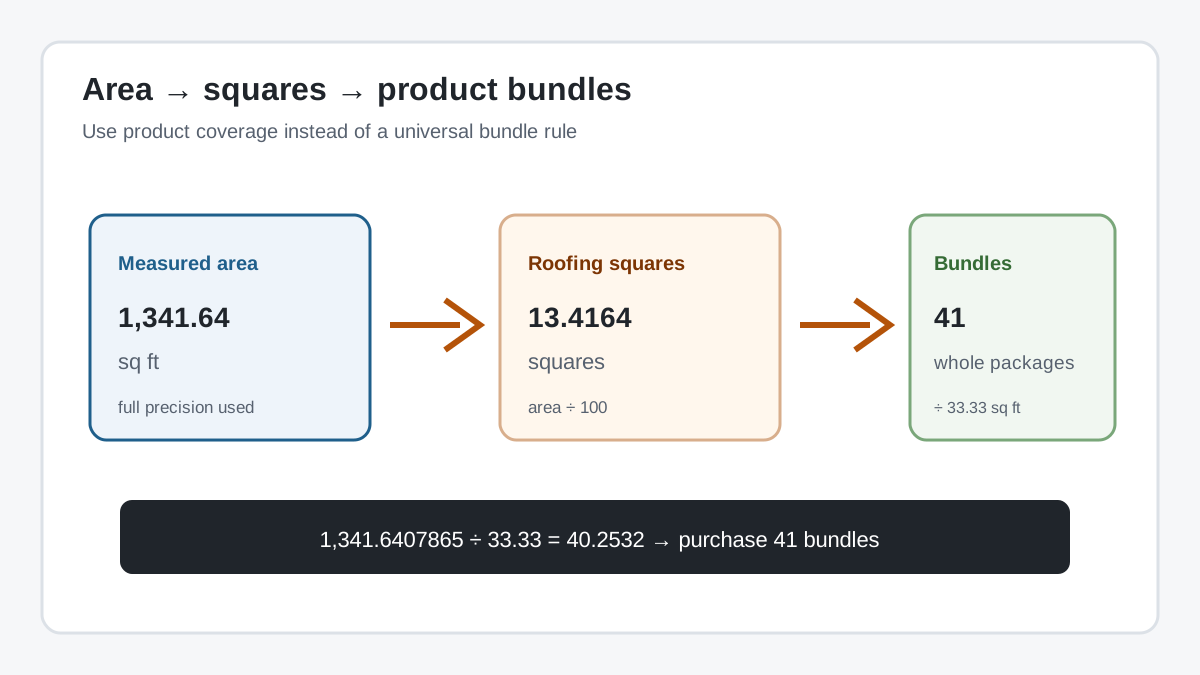
Inputs: Roof area = 1,341.6407865 sq ft; product coverage = 33.33 sq ft per bundle.
Calculation: Squares = 1,341.6407865 ÷ 100 = 13.416407865 squares. Bundles = 1,341.6407865 ÷ 33.33 = 40.2532 bundles before purchase rounding.
Result: The area converts to 13.42 displayed squares. The product quantity rounds up to 41 bundles.
Rounding: Use the unrounded area for both divisions. Display squares to two decimals, retain the bundle calculation at full precision, and round the physical package count up once.
Compare the result before you buy
- Confirm the package coverage belongs to the exact product and exposure you plan to use.
- Keep starter strip, ridge cap, underlayment, ice-and-water barrier, flashing, and nails as separate scopes unless a quote explicitly bundles them.
- Check whether the quote uses roof area, squares, bundles, or another unit before multiplying by a price.
- Keep a documented waste allowance visible instead of hiding it inside product coverage.
The calculator gives a traceable quantity estimate. It does not optimize cuts, decide the installation layout, or guarantee that a supplier’s package count covers every accessory.
Conclusion
Use squares to describe area and bundles to plan product packages. When the product coverage is known, the bundle calculation is more defensible than a universal package shortcut. Carry the same measured area, product coverage, and clearly stated waste assumption into the quote or material list.