
Gutter quantity begins with the installed path around the house, not the roof footprint. Measure each eave run that receives gutter, add the runs, and then divide by the product section length to estimate how many stock sections the run requires.
Measure the installed gutter runs
Walk the eave line or use a measured drawing and divide the work into runs. A run is one continuous installed length for the scope you are pricing. Record corners, outlets, and changes in elevation separately so they are not lost inside one number.
- Identify every eave edge that will receive gutter.
- Measure each run along the planned gutter path and record feet or another consistent length unit.
- Enter up to three runs in the Gutter Length Calculator, leaving unused optional rows blank.
- Add the total linear feet before choosing stock section quantities.
- Use the section calculator only after you know the total run and the product section length.
Formula and field notes
total length = run 1 + run 2 + run 3; sections = ceiling(total length ÷ section length)
- Run 1–3
- Measured installed gutter runs in feet.
- Total length
- Sum of the runs, in linear feet.
- Section length
- Stock length of one gutter section.
Blank optional runs contribute zero. The calculator does not infer corners, outlets, elbows, end caps, or downspout routes.
| Situation | What to do |
|---|---|
| Inside or outside corner | Measure each installed run once; do not count the corner as extra footage unless the product layout requires it. |
| Separate roof section | Record it as another run when it receives a distinct gutter length. |
| No gutter on an edge | Do not include that edge in the total. |
| Different stock lengths | Calculate each product or stock length separately. |
Worked example: three eave runs
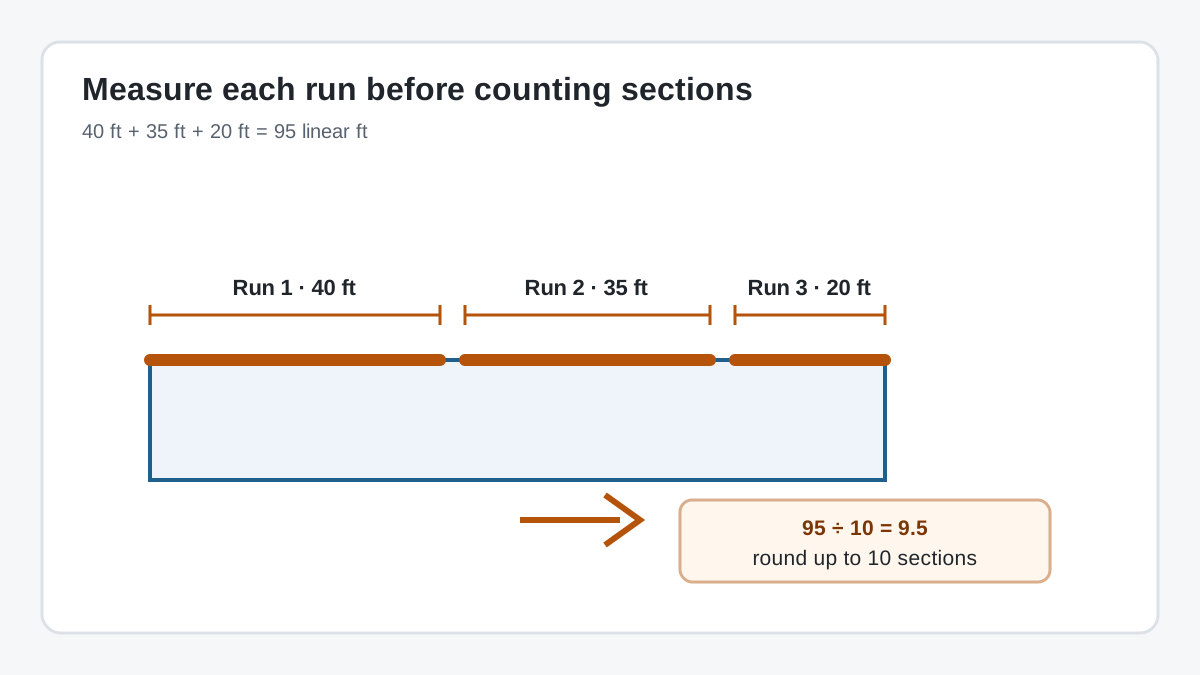
Inputs: Run 1 = 40 ft; run 2 = 35 ft; run 3 = 20 ft; stock section length = 10 ft.
Calculation: Total length = 40 + 35 + 20 = 95 linear ft. Sections = ceiling(95 ÷ 10) = ceiling(9.5) = 10 sections.
Result: The Gutter Length Calculator displays 95 linear ft. The Gutter Section Calculator displays 10 sections.
Rounding: Keep 95 ft as the measured total. Only the stock section count rounds up; do not round each run separately before adding them.
Carry the length into a parts takeoff
Use total length as the starting quantity for sections, hangers, and material cost. The combined parts takeoff can also use a selected hanger spacing and downspout count, but it intentionally excludes corners, elbows, end caps, endpoint placement, and per-run cut allocation.
- Use the same run total when comparing a material quote and an installation quote.
- Keep downspout count separate from gutter footage.
- Use the selected stock length for section rounding.
- Review each fitting category rather than treating a footage total as a complete bill of materials.
Conclusion
A reliable gutter length starts with measured installed runs. Add the runs once, preserve the total footage, and round only the stock quantity that requires whole sections. This keeps the measurement, material takeoff, and cost comparison connected without pretending that footage alone designs the drainage system.